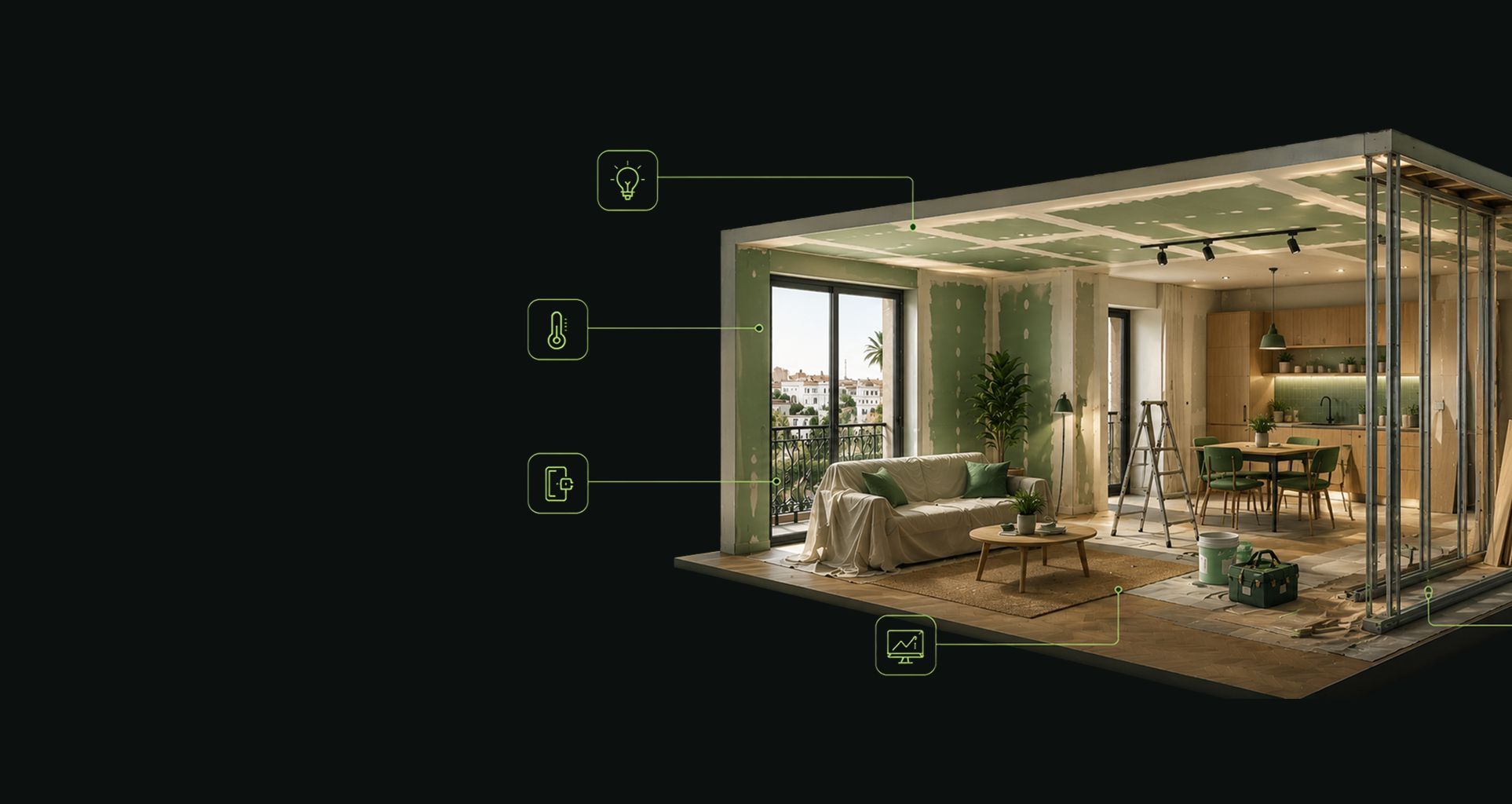
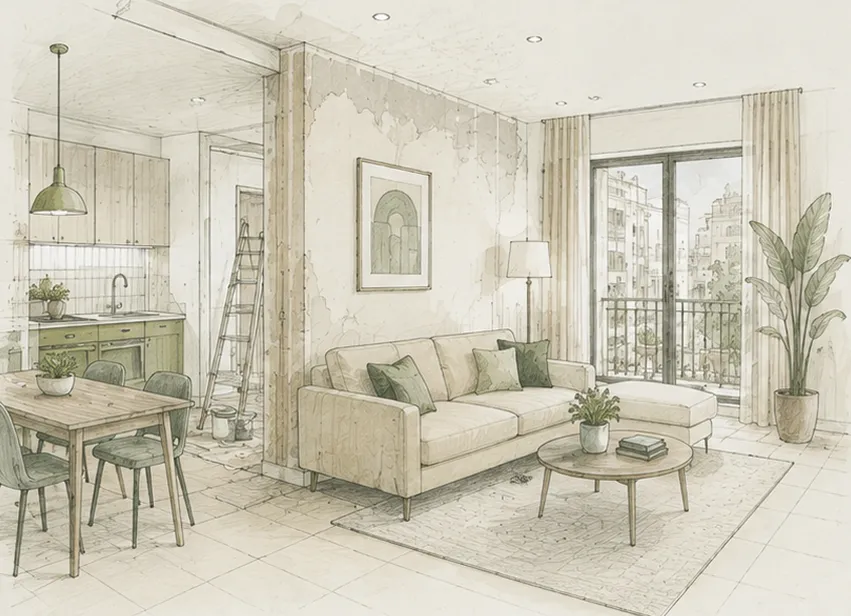
Apartment undergoing light renovation, partitions open and tools still present, its controlled functions marked one by one — lighting, temperature, access and monitoring.

Landlords

Home automation for Airbnb and short-term rentals in Morocco

The occupant changes every three days and has never set foot in the property. The owner is often several hundred kilometres away. That pairing decides what is worth installing — and what is not.

Short-term rentals: what has to work for someone who has learned nothing

A rental property has neither a permanent occupant nor anyone on site. Whoever uses it discovers everything on arrival, often at night, often tired. Whoever owns it has to understand from a distance what is wrong. Two principles follow, and they rule out most of what usually goes by the name of home automation.

“Powered by IBT” and “Secured by IBT” seals applied to completed installations.
  1. 01

    Nothing must have to be learned

    No scenarios, no moods, no app to install. A switch turns on the light, a door opens with a code, a thermostat shows a temperature. Anything that needs explaining will produce a message at midnight, then a line in the review.

  2. 02

    Everything must be diagnosable remotely

    The owner is not on site and will not be before the next changeover. What matters is not the finesse of the control but the ability to see, from a phone, whether the code works, whether the air conditioning is running with a window open, and whether the Wi-Fi is genuinely up.

What to install in a short-term rental, block by block

Eight blocks, always in the same order. On this property type, half of them are ruled out — and that is the most useful result on this page.

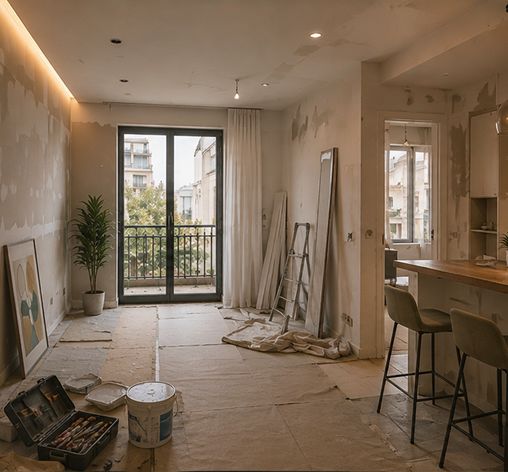
Architect's sketch of the living room of a furnished apartment being refreshed, stepladder and paint pot beside a partition, balcony overlooking the city.

Let apartment, light renovation

An already furnished dwelling, let as it stands. No building work, no rework of the panel, and a budget that has to pay for itself in a few months of bookings.
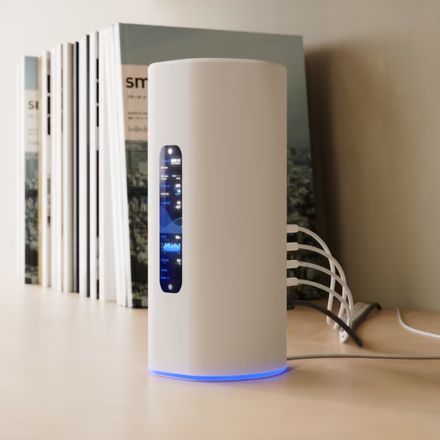
  1. All-in-one UniFi gateway sitting on a shelf, small display showing network statistics and Ethernet cords plugged in at the back.

    Backbone — network and Wi-Fi

    Essential

    The only item in this scenario whose absence shows up in public reviews. Everything else is secondary beside it.

    Coverage and bandwidth
    One decent router and a well-placed access point beat three repeaters. Size for a group on holiday: several screens at once, not one occupant checking email.
    • UniFi
    Guest network
    An isolated guest network, with a password simple enough to copy from a welcome book. The guest must reach neither the cameras, nor the thermostat, nor the owner's storage.
    • UniFi
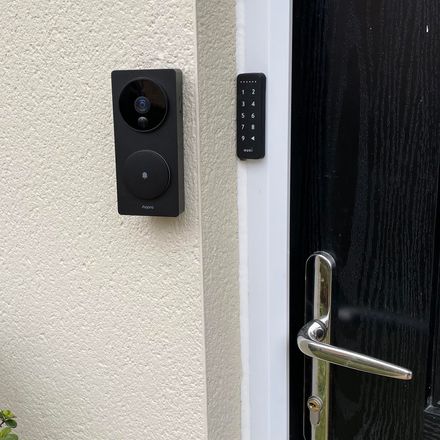
  2. Aqara video doorbell and a code keypad fixed to the wall at the entrance of a dwelling — the door keeps its original mechanical handle.

    Security and access control

    Essential

    The number one item in this scenario — the one that removes the key handover, therefore the journey, therefore the constraint that stops the property being let.

    Temporary keypad lock
    One code per stay, revoked automatically at checkout. Mechanical override mandatory and a reachable local contact: a flat battery at 11 pm must not leave someone outside.
    • Aqara
    Detection
    A connected smoke detector, reporting to the owner. It is the one safety sensor that needs no arguing for on this kind of property.
    • Aqara
    Video
    On outside entrances only, never indoors. The limit is stated explicitly to the guest in the listing: it is a mark of seriousness before it is a legal precaution.
  3. Automation

    Optional

    As little as possible, and that is advice rather than a budget reservation. A let property does not need scenes — it needs to work for someone who has learned nothing.

    Lighting
    Conventional switches. One or two connected lamps at most, as accents, and never on the primary lighting.
    • Govee
    Air conditioning
    Connected thermostat with a setpoint ceiling and cut-off on window opening. The only item in this scenario with a demonstrable payback: it pays for itself in one season.
    • Aqara
  4. Energy

    Recommended

    Electrical sub-metering, in order to know. Without measurement, abnormal consumption only surfaces on the bill, months after the stay that caused it.

    Sub-metering
    A communicating meter on the dwelling's incomer. It turns a hunch into a fact, and lets you tell the next guest what is included.
    • Aqara
  5. Outdoors

    Ruled out

    An apartment has no gate, no pool and no irrigation. The block has no object here, and putting it in a quote would be selling thin air.

  6. Audio and video

    Ruled out

    A connected speaker in a transient dwelling is a personal account left behind, a history attached to someone who has gone, and an object that disappears. The television is enough.

  7. Supervision and interfaces

    Optional

    A manufacturer's app is enough if the owner is not technical. Adding a supervision layer here means adding one more thing that can fail.

    Remote monitoring
    The app of the chosen brand — provided you choose one. Three apps for three devices means three forgotten passwords on the day something needs doing.
    • Aqara
  8. Ecosystem and assistants

    Recommended

    One ecosystem, chosen before buying anything. That is what avoids ending up with four gateways for six devices.

    The choice
    Aqara covers lock, thermostat, detection and sensors on a single hub, and stays compatible with both Apple HomeKit and Google Home. On this segment, consistency beats the performance of each item taken separately.
    • Aqara
    • Apple HomeKit
    • Google Home

What we advise against in this case

KNX, without ambiguity. Neither the budget nor the use justifies it on a dwelling of this kind, and we say so rather than stretch the quote.

And if your need comes down to a lock, a thermostat and Wi-Fi: you can do it yourself, and we are not the right people to call. We come in from the point where there are several units to manage, charges to apportion, or a building to take over.
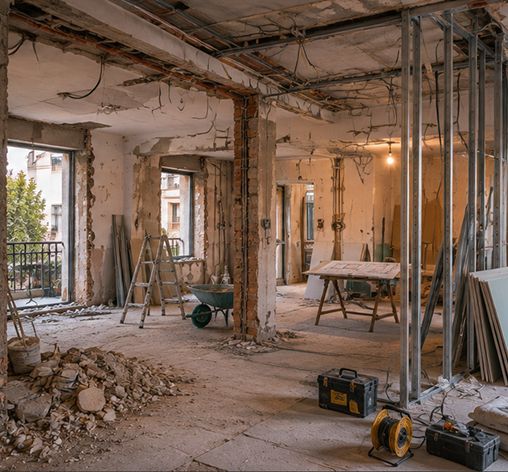
Riad or villa let short-term, major renovation

Several bedrooms or several units, rewired electrics, a manager on site or nearby. The property is run like a small establishment, not like a home.

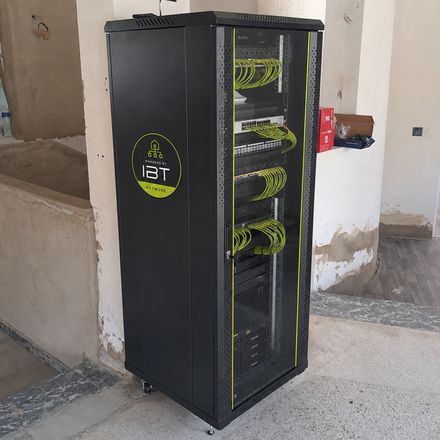
  1. IBT patching cabinet installed on a site still being finished, glazed door showing the patch panels, the switches and the green patch cords combed level by level.

    Backbone — network and Wi-Fi

    Essential

    A riad is not a large apartment. Thick walls, courtyards, irregular thicknesses — it is a design question, not one more access point.

    Survey first
    Coverage survey before pricing, not after. It is the only way to quote a number of access points that holds, and to avoid the budget increase at the end of the project.
    Distribution
    UniFi over PoE, cabling pulled while the chases are open. One access point per zone, courtyards included where they are used in the evening.
    • UniFi
    Separated networks
    Guest network isolated from the operations network. Cameras, locks and supervision share nothing with the guests' Wi-Fi.
    • UniFi
  2. Aqara video doorbell and a code keypad fixed to the wall at the entrance of a dwelling — the door keeps its original mechanical handle.

    Security and access control

    Essential

    Several bedrooms let separately means several independent entries — and a clear limit on what is filmed.

    Access per bedroom
    Keypad lock per bedroom, revoked at checkout, master for the manager. Mechanical override on each.
    • Aqara
    Video
    UniFi Protect on entrances and common areas only, on the network controller. Never in private spaces — this is stated explicitly on the page as in the listing, and it is a mark of seriousness before it is a precaution.
    • UniFi
    Safe
    One safe per bedroom. The cheapest item that most changes how a guest perceives the property.
  3. Automation

    Recommended

    Simple scenes, few in number, driven by a clock rather than by the occupant. Nobody, neither guest nor manager, will ever adjust them.

    Core system
    Partial KNX where the electrics are being redone and the circuits run back to the panel, hybrid otherwise. The bus earns its place here through the number of units, not through refinement of control.
    • KNX
    Lighting
    Scenes by zone — courtyard, terrace, bedrooms — on an astronomical clock. No multi-setting moods: they will be set once and never touched again.
    • KNX
    Air conditioning
    Control per bedroom, setpoint ceiling, away mode across the property. The manager must be able to put everything back to rest between stays in one action.
    • KNX
    • Aqara
  4. Energy

    Essential

    As soon as a property is split into several units, metering stops being a comfort and becomes the basis of every discussion about charges.

    Sub-metering per unit
    One meter per dwelling or per bedroom depending on how it is operated. It goes in while the panel is being redone, or it does not go in at all.
    • KNX
    Monitoring
    Consumption history per unit, available to the manager. That is what turns a suspicion into a fact.
    • Home Assistant
  5. Outdoors

    Recommended

    Courtyard, pool and terrace make the property's rental value. They are controlled, but soberly.

    Pool and lighting
    Filtration on a clock, exterior lighting on an astronomical clock, technical alarms reported to the manager. Nothing that requires the guest to intervene.
    • KNX
  6. Audio and video

    Optional

    Courtyard sound can be justified on a high-end property. It is pre-wired during the works and decided later.

    Pre-wiring
    Runs pulled to the courtyard and terrace while the chases are open. The equipment can wait a season.
  7. Supervision and interfaces

    Essential

    The manager needs one screen showing the state of the property, unit by unit. That is what separates this scenario from the previous one.

    Dashboard
    Home Assistant on a local box, one panel per unit — access, temperature, consumption, alarms. Available remotely, without depending on an online service to function.
    • Home Assistant
  8. Ecosystem and assistants

    Optional

    Voice assistants have no use in let bedrooms. They may have one in the manager's own quarters, if the manager lives on site.

    Scope
    Apple HomeKit or Google Home exposed from Home Assistant, for the manager alone. Bedrooms stay on physical controls.
    • Apple HomeKit
    • Google Home
    • Home Assistant

What we advise against in this case

Video in private spaces, without exception and whatever justification is put forward. We also advise against complex scenes that nobody will be able to take over after we leave: a riad changes manager often, and an installation that requires calling us back to move a lamp is not a good installation. Finally, if the property has a single unit and no manager, the previous configuration is enough — there is no point paying for a bus to serve three bedrooms let together.

What is decided before the first booking

There is not always a building project, but there are always decisions — and three of them become expensive once the property is trading.

  1. Before the listing goes liveHow guests get in. Keypad lock, key box or handover in person — this is what decides whether the property can be let without someone travelling to it, and therefore its real yield.
  2. Before splitting the propertySub-metering per unit. Dividing a riad into four dwellings without metering them separately means giving up any discussion about charges, and discovering the drift on an annual bill.
  3. Before ordering equipmentA Wi-Fi coverage survey. Thick walls and courtyards are not solved with one more repeater, and this is the leading cause of poor reviews.
  4. Before the first code is issuedThe fallback procedure. What happens if the code does not work at 11 pm? The answer has to exist before it is needed — a mechanical override, a local contact, a written procedure.

The most common mistakes on an Airbnb or Booking property in Morocco

They rarely cost much to fix, but they are paid for in public reviews, which costs more.

A smart lock with no way out

A flat battery, a network outage, a code sent to the wrong person — and the guest is outside, at night, in a foreign country. Any lock on a main door must keep a mechanical override and a reachable local contact.

Wi-Fi sized for a home, not for a stay

Four people each watching a screen do not consume like a couple checking email. Coverage and bandwidth are sized on the real use of a group on holiday, not on that of a permanent occupant.

Air conditioning with no setpoint ceiling

A guest leaving for the day at 17 °C with a window open has no reason to do otherwise — the bill is not theirs. This is the only item on this segment with a demonstrable payback.

Too much automation

Mood scenes, connected bulbs, a dedicated app. Nobody uses them, everybody complains about them, and the owner ends up unplugging the lot before having it removed.

Cameras in the wrong place

A camera covering a private space is a dispute, not security. Video is limited to entrances and common areas, and that limit is stated explicitly to the guest.